
REPORTER: CHRISTIAN NWANGENE
The Christian Council of Nigeria (CCN) and Jama’atu Nasril Islam (JNI), under the umbrella of the Nigeria Religious Coalition on Artificial Intelligence (NRCAI), have warned that artificial intelligence (AI), if left unregulated, risks becoming a “digital idol,” potentially undermining religious values, human dignity, and moral conscience.
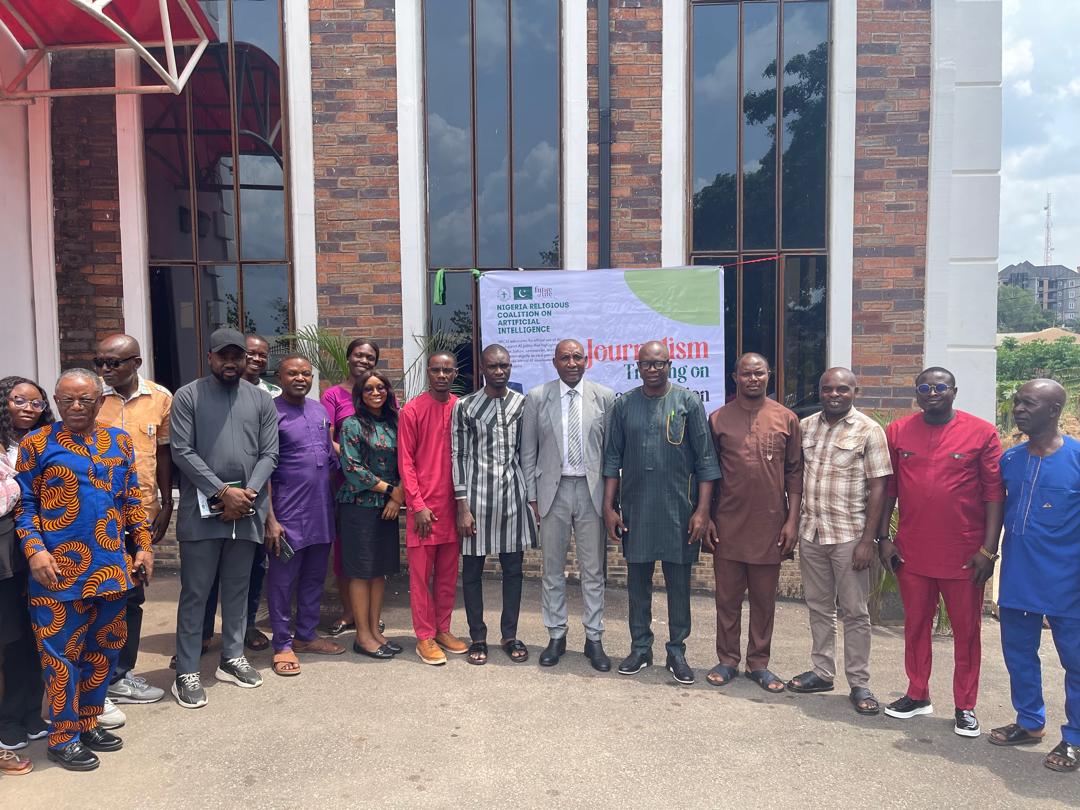
The warning was issued on Tuesday in Enugu during a one-day capacity-building workshop for journalists, designed to deepen understanding of the opportunities and ethical challenges posed by AI in public communication and reporting.
Speaking for the coalition, the Director of the CCN Institute of Church and Society, Ibadan, Very Rev. Kolade Fadahunsi, stressed that while AI holds immense transformative potential, its misuse particularly in spreading misinformation threatens social cohesion and public trust.
“We appeal to all people of goodwill to unite in ensuring that AI serves humanity, rather than becoming an idol that captivates and misleads,” Rev. Fadahunsi said. “Through dialogue, collaboration, and ethical stewardship, we can guide AI to support justice, peace, and human dignity.”
He called on policymakers, media professionals, scientists, and community leaders to participate actively in shaping ethical AI policies grounded in accountability, compassion, and respect for human values.
Rev. Fadahunsi highlighted the media’s critical role in an AI-driven information ecosystem, cautioning journalists against uncritical adoption of AI-generated content. He warned that inaccuracies could inflame tensions, especially in a society where religious sensitivities intersect with public discourse.
“In an era where synthetic content can be mistaken for reality, journalists must uphold rigorous verification and editorial discipline to prevent the spread of falsehoods capable of triggering unrest,” he said.
Echoing these concerns, the Chief Imam of Imo State, Yusuf Suleman Njoku, described AI as a double-edged tool, whose societal impact depends on governance and responsible usage. He cited recent cases of AI-generated statements falsely attributed to prominent religious figures, including Sheikh Ahmad Gumi, as evidence of AI’s potential to mislead believers.
“If left unchecked, AI could become a digital idol venerated, unquestioned, and capable of shaping beliefs contrary to divine and moral order,” Njoku warned.
He stressed that AI should complement human effort, uphold ethical standards, and reinforce moral values rather than supplant them.
The NRCAI’s position mirrors a growing global discourse on responsible AI governance, particularly as concerns rise over deepfakes, algorithmic bias, and autonomous systems that operate beyond human oversight.
Journalists attending the workshop were urged to adopt robust digital verification practices, strengthen ethical reporting standards, and remain vigilant against unintended consequences of AI in shaping public opinion and societal norms.
“AI must remain a servant of humanity, not a digital idol that dictates truth or moral direction,” the coalition concluded.